.svg)
10 AI Chatbot Trends Reshaping Customer Service in 2026 and Beyond

Remember when a chatbot was just a little pop-up in the corner of a website that asked if you needed help, and then immediately confused itself? Yeah, those days are firmly behind us.
Today's AI chatbots hold multi-turn conversations, pull live order data, detect customer emotion, and take actions like processing refunds or booking appointments without a human typing a single word, and the pace of change has not slowed down. 95% of customer interactions are forecast to be AI-powered in the near future, and the global chatbot market is projected to grow from $7.76 billion in 2024 to $27.29 billion by 2030.
If you run a business that deals with customers, that trajectory is not a background statistic. It is a signal about where your competitors are moving and what your customers will start expecting from you.
It can be a lot to take in at once, so if you want to get a handle on the basics of AI customer service before we dive into the deep end, that’s a great place to start. In this post, we’re looking at the shifts already changing the game, why they’re happening, and what they actually mean for your day-to-day, including how these trends connect to the tools handling real customer interactions right now.
Before we get into what's coming, here's how much has already changed:
What Are AI Chatbot Future Trends, and Why Should You Care?
AI chatbot trends are the directional shifts in how chatbot technology is being built, deployed, and used in customer-facing environments. They are shaped by three things: what the underlying AI technology can now do, what customers have started expecting, and what businesses have learned from early deployments that did and did not work.
Why does it matter which way these trends are pointing? Because 80% of organizations are already deploying or exploring generative AI to improve their internal workflows and products, and 65% of CX leaders are doubling down on AI investments to transform their support from a cost center into a growth engine. The businesses that understand where the technology is heading are making smarter infrastructure decisions today. The ones that wait will be playing catch-up while their competitors are already delivering a noticeably better customer experience.
The other reason to pay attention: customer expectations are moving with the technology. Once your customers experience instant, accurate, personalized support elsewhere, they carry that expectation everywhere. So, the benchmark shifts whether you are ready or not.
How AI Chatbots in Customer Service Work
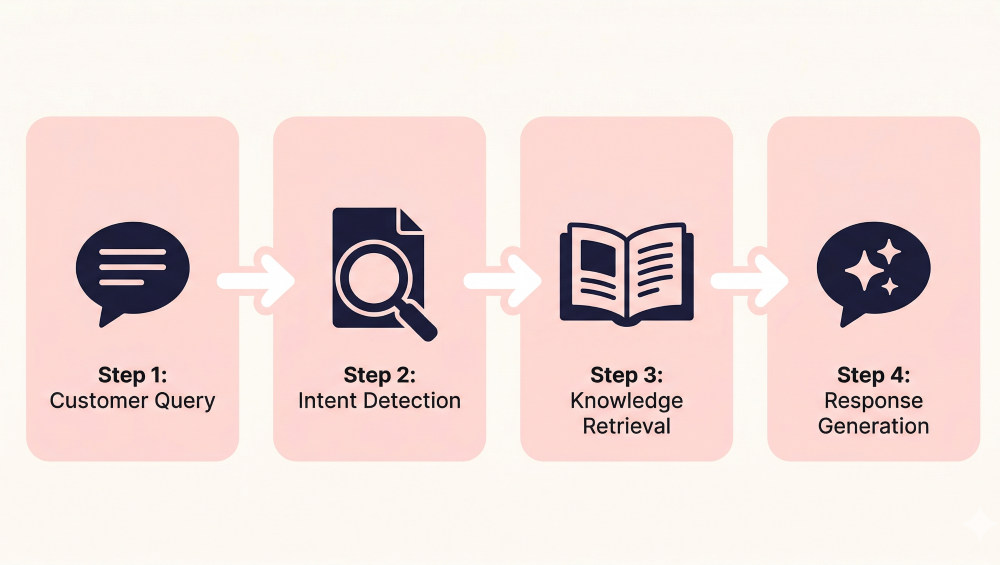
Before getting into the trends, it helps to understand the mechanics, because several of the biggest shifts happening right now are changes to how chatbots are built rather than just what they do.
Modern AI chatbots run on large language models (LLMs) that are trained on enormous datasets of human language. When a customer sends a message, the model interprets the intent (not just the literal words), searches connected knowledge sources for relevant information, and generates a natural-sounding response in real time. The process happens in seconds.
What makes current-generation chatbots meaningfully different from their predecessors is context retention. Earlier bots treated every message as isolated. Today's models hold the thread of a conversation across multiple turns, remember what the customer said three messages ago, and adjust their response accordingly. Add a live integration with your CRM, order management system, or knowledge base, and the chatbot can also pull real customer data into that response.
The next evolution, which several of the trends below are pointing toward, is agentic AI: chatbots that do not just generate responses but take actions. Create a return. Update a subscription. Trigger a refund. These are no longer hypothetical capabilities. They are live in the tools that are defining the leading edge of conversational AI in 2026, and in the years to come.
AI Chatbot Future Trends to Watch in 2026 and Beyond
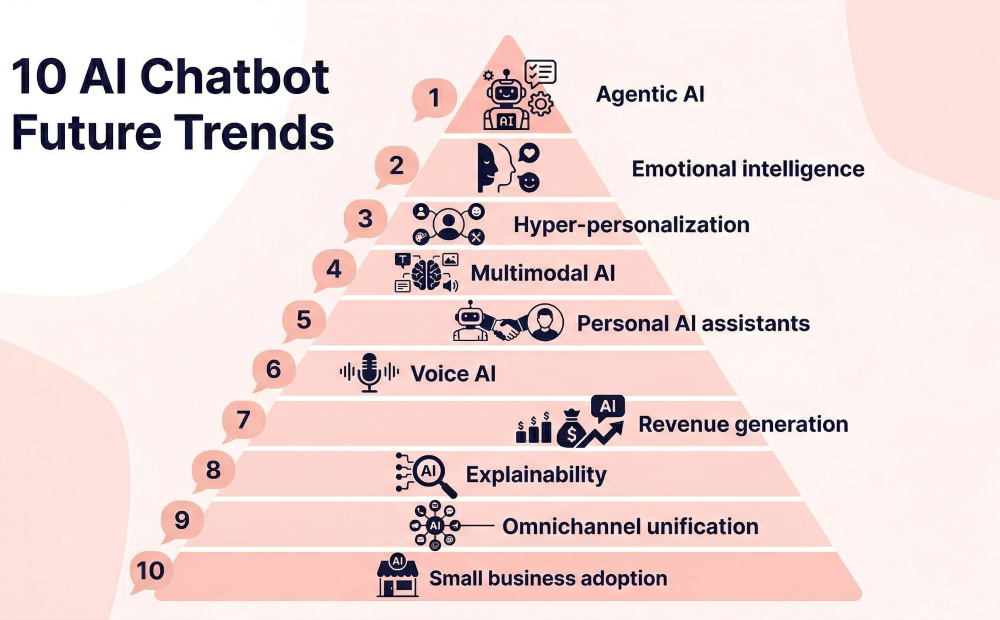
1. Agentic AI: From Answering to Acting
Agentic AI is chatbot technology that completes tasks inside your systems and it is changing what automated customer service can accomplish.
An agentic AI does not say "here is how to process your return." It processes the return. It can interact with multiple backend systems in sequence: check return eligibility in your OMS (Order Management System), generate the prepaid label, update your CRM, and send a confirmation to the customer, all within a single conversation. Back in 2022, Gartner projected that conversational AI would reduce contact center labor costs by $80 billion by 2026, and we're now seeing that reality take shape as these agents take over the routine, multi-step tasks that used to require a human.
This trend is the reason the word 'chatbot' is gradually being replaced by 'AI agent' in how the industry talks about these tools. The distinction is not just semantic. It changes what is possible and what you should expect from any platform you evaluate.
What This Means For Your Business
For your support team, this means evaluating whether your current chatbot platform supports action-taking. Platforms that can only generate responses will feel outdated within 18 months. The question to ask your vendor: can the bot process a return, update an address, or trigger a refund or does it just tell the customer how to do those things themselves?
2. Multimodal AI Agents: Beyond Text
For most of chatbot history, the interface was text in, text out. Multimodal AI agents change that entirely. In 2026, customers can share a photo of a damaged product and get an instant resolution. They can describe a problem by voice and receive a visual step-by-step guide in response. They can switch between text, voice, and video within a single support thread without losing context.
The numbers behind this shift are significant. 76% of consumers now want to use text, images, and video in the same support thread without starting over, and 79% of CX leaders say customers expect the option to use video or visual sharing during support interactions. Among organizations with mature AI deployments, 93% of their AI agents already handle at least one non-text medium, proving that the era of the text-only chatbot is officially coming to an end.
Multimodal support is not just a channel preference. It is a workflow change. Support teams built around text tickets will need to adapt how they train AI models, how they define resolution, and how they measure performance as voice and visual inputs become standard.
What This Means For Your Business
If your customers are already sending photos of damaged products or leaving voice notes on WhatsApp, your current setup may not be capturing that context properly. Evaluate whether your chatbot platform can ingest images and voice as inputs, not just text, before your competitors make multimodal the default expectation in your category.
3. Hyper-Personalization Through Memory-Rich AI
Memory-rich AI is technology that retains customer context across separate sessions and it is changing the baseline expectation for what personalised support feels like.
These systems retain context across sessions, so a customer who contacted support about a shipping delay two weeks ago does not have to explain their order history when they follow up today.
The demand for this capability is clear: over 67% of customers now expect brands to offer more personalization, particularly since AI has the demonstrated ability to analyse past interactions and deliver on it. The gap between a chatbot that treats every conversation as new and one that remembers, adapts, and anticipates is the difference between a tool that frustrates and one that genuinely builds customer loyalty.
Memory-rich AI also enables predictive support. Rather than waiting for a customer to report a problem, the system recognizes patterns (a shipping delay, a failed payment, a subscription renewal approaching) and initiates the conversation first. This shift from reactive to proactive is one of the defining AI trends in customer support for the next two to three years.
What This Means For Your Business
Start by auditing how much context your current chatbot carries between sessions. If the answer is none, every repeat customer is starting from scratch. Memory-rich AI is the single biggest lever for turning automated support from a friction point into a loyalty driver. Prioritize platforms with cross-session memory on your next evaluation.
4. Emotional Intelligence and Sentiment-Aware Responses
Early AI chatbots were functionally tone-deaf. They could answer a question but couldn't tell the difference between a curious customer and a frustrated one. That is changing fast. AI chatbots are increasingly equipped with emotional intelligence, enabling them to detect and respond to customer emotions by adjusting tone, escalation priority, and response style based on real-time sentiment signals.
In practice, this means a chatbot handling a post-delivery complaint from a visibly frustrated customer will respond differently than it would to a routine tracking inquiry, even if the underlying query is similar. It will soften its tone, prioritize speed, and escalate earlier if the emotional signals indicate the customer is nearing the edge of what automation can usefully handle.
This capability also feeds into AI-backed CSAT measurement. Instead of relying on the tiny fraction of customers who fill in a post-conversation survey, AI analyzes every conversation for sentiment signals and calculates a satisfaction score automatically. It’s real-time, unbiased, and far more representative than anything a survey can produce.
What This Means For Your Business
This is especially relevant if you are operating in a category where post-purchase frustration is common: fashion, electronics, logistics. A chatbot that detects escalating sentiment and routes proactively will catch complaints before they become reviews. Ask your platform vendor specifically how sentiment detection works and whether it affects escalation routing.
5. Conversational AI 2026: Voice Is Having a Moment
Voice AI is natural language support delivered through spoken interaction rather than typed text and it is changing how customers expect to reach brands across phone, WhatsApp, and smart devices, 80% of leaders foresee voice AI becoming a primary support channel by 2026. In retail and healthcare, voice-enabled chatbots are handling appointment scheduling, prescription queries, and order status updates with accuracy rates that were not possible two years ago, often exceeding 95% in specialized medical and logistical contexts.
The broader shift here is the convergence of voice and text into a single continuous experience. A customer might start a support conversation by typing, switch to voice when they step away from their screen, and return to text to receive a confirmation link. The AI maintains context across all of it.
For businesses planning their customer support infrastructure, voice is no longer a future consideration. It is a current one. Conversational AI in 2026 is multi-modal by default, and platforms that only handle text are already behind the capability curve.
What This Means For Your Business
If most of your customer conversations are happening on voice-native channels (phone, WhatsApp voice notes), a text-only chatbot is already missing a significant share of your volume. You do not need to rebuild everything, but knowing which channels your customers prefer is the starting point for deciding where voice AI belongs in your stack.
6. Personal AI Assistants Contacting Businesses on Behalf of Customers
AI-to-AI support is when a customer's personal AI assistant contacts your brand's support system on their behalf and it is changing who (or what) is on the other end of a service interaction.
Rather than customers interacting directly with a brand's chatbot, personal AI assistants (think Apple Intelligence, Google Gemini, or similar) will increasingly act as intermediaries: the customer asks their own AI to handle a return, and that AI contacts the brand's support system on their behalf.
The interface shifts from human-to-bot to bot-to-bot: a customer's personal AI talking to a brand's AI agent to resolve an issue without any human typing anything. This is not a 2030 scenario. Early versions of this interaction are already live in specific verticals, and the major platform providers are racing to make it standard.
What does this mean for your business? Your AI support infrastructure will need to be designed not just for human customers but for AI agents acting on their behalf. Businesses that build clean, well-documented APIs and structured support workflows today are building the foundation for this interaction model.
What This Means For Your Business
This trend requires proactive infrastructure decisions more than reactive ones. If your support API is poorly documented or your chatbot can only handle human-phrased queries, it will fail when an AI agent tries to interact with it. Start by ensuring your support workflows are cleanly structured and that your platform has well-documented integration capabilities.
7. AI Chatbots Becoming a Revenue Channel, Not Just a Cost Center
The framing of AI chatbots as a cost reduction tool is accurate but incomplete. Ecommerce companies using AI chatbots see a 36% increase in repeat purchases through automated post-sale engagement. Sephora reported an 11% increase in conversion rates after deploying AI-assisted product recommendations. Overall, AI adopters are reporting up to a 12% boost in CSAT and a 4% increase in annual revenue growth.
The mechanism is straightforward. An AI chatbot that catches a cart abandoner, answers the question holding them back, and completes the sale is acting as a sales assistant, not a support agent. One that proactively recommends a complementary product after a purchase is doing the work of an upsell rep. AI chatbot trends in 2026 increasingly reflect this dual role, and businesses that only measure chatbot performance through support metrics are leaving revenue impact invisible.
What This Means For Your Business
If you are only measuring your chatbot against support metrics: ticket deflection, resolution rate, CSAT, you are missing half the picture. Add revenue-side KPIs: cart recovery rate, upsell conversion from chatbot-initiated interactions, and repeat purchase rate among customers who engaged with the bot post-purchase. Those numbers tell the full story.
8. Omnichannel Unification: One AI Across Every Channel
Customers do not think in channels. They think in conversations. A customer who reaches out on WhatsApp today and follows up on Instagram tomorrow expects you to know who they are and what they already discussed. AI trends in customer support are converging on unified AI agents that operate across all channels simultaneously from a single backend, rather than separate bots deployed channel by channel.
The real issue here is that a fragmented approach just doesn't work for the customer. When support is siloed, people end up repeating themselves, agents have to jump between tools, and important context inevitably gets lost. A unified AI architecture fixes this by keeping a single, continuous conversation record, no matter where the customer reaches out. This connected way of handling customer messaging is what makes the difference between a frustrating experience and one that actually feels seamless across every channel.
What This Means For Your Business
The practical implication: if your chatbot is deployed channel by channel with separate knowledge bases and separate conversation histories, you are building technical debt. Consolidating to a unified AI architecture is a platform decision, not a content one. Prioritize this on your next vendor review if you are managing three or more customer-facing channels.
9. Explainability and Trust: Customers Want to Know Why
As AI handles more consequential interactions like billing decisions, account changes, and sensitive queries, customers are starting to ask: why did the AI say that? The majority of customers now want to understand why AI made specific choices that affected them. This is pushing platforms to build explainability into their AI layers so that decisions can be traced and communicated transparently.
For businesses, this trend has compliance implications as well as experience ones. Regulations around automated decision-making are tightening in multiple markets, and the platforms that invest in audit trails and explainable AI now are building a genuine competitive and compliance advantage.
What This Means For Your Business
For businesses in regulated industries: financial services, healthcare, insurance, this is already a compliance requirement in several markets. For everyone else, it is a trust signal. Customers who understand why the AI said what it said are more likely to accept the response and less likely to escalate. Check whether your platform logs decision rationale.
10. Rapid Small Business Adoption
AI chatbot technology used to be an enterprise purchase, but that has changed decisively. 64% of small businesses plan to adopt AI chatbots by 2026, up from 38% in 2024. No-code platforms, free-tier entry points, and 15-minute setup workflows have made what once required a developer and a significant budget accessible to a business with five employees and a Shopify store.
This democratization is a huge deal because it's shifting what we consider 'normal' service. When your competitors, no matter how small they are, can offer 24/7 support and proactive help, relying on a slow, manual email process becomes a glaring weakness. The tools are right there for the taking; it's really just a matter of who decides to use them.
What This Means For Your Business
If you have been waiting for a better time to start, the competitive window is narrowing. When 64% of small businesses are adopting AI chatbots by end of 2026, the question is no longer whether you need one, it is whether you are already behind. A free-tier plan on a platform like Heyy is a lower-risk starting point than waiting for your workflow to become visibly broken.
How to Prepare Your Business for These Chatbot Trends
Knowing where the technology is heading is one thing. Having a clear action plan is another. Here is a practical 5-step framework for moving from aware to prepared.
1. Audit your current chatbot setup
Map what your existing tool can and cannot do. Can it take actions, or just generate responses? Does it retain memory across sessions? Which channels does it cover? A clear audit of current capability shows you exactly where the gaps are.
2. Identify 2–3 automation workflows to test first
Start with your highest-volume, most repetitive queries, order tracking, returns, FAQs. Pick two or three workflows where automation would have the most immediate impact and run a focused pilot before expanding scope.
3. Evaluate your platform's roadmap
Ask your current vendor (or vendors you are evaluating) directly: what is on their AI roadmap for the next 12 months? If agentic capability, multimodal support, and cross-session memory are not on it, you may be building on infrastructure that will fall behind.
4. Train your team on AI handoffs
Your human agents need to know how to work with AI escalations, not around them. That means understanding what context the AI transfers, how to pick up mid-conversation without making the customer repeat themselves, and when to escalate back to AI after resolution.
5. Set baseline KPIs before you scale
Before expanding automation, define what success looks like: automated resolution rate, escalation rate, CSAT on AI-handled conversations, cart recovery rate if applicable. Baselines give you a benchmark to improve against and make it easier to justify further investment.
Where These AI Chatbot Trends Are Playing Out in Practice
These trends are not theoretical. Here is where they are showing up in real business operations right now:
- Ecommerce: AI agents handle order tracking, returns, and product discovery. Proactive cart abandonment messages via WhatsApp and Messenger recover 20 to 35% of abandoned carts. Post-purchase AI sequences drive a 36% increase in repeat purchases (Gorgias).
- Financial services: AI detects suspicious activity in seconds, handles balance queries and card management, and uses voice AI for authentication. Speed equals trust in this sector, and AI is delivering both.
- Healthcare: Appointment scheduling, prescription refill reminders, and pre-visit information delivery are now handled by AI agents, freeing clinical staff for the interactions that genuinely need human judgment.
- SaaS and subscription businesses: AI handles onboarding, feature FAQs, billing queries, and renewal conversations. Sentiment detection routes at-risk customers to human agents before they churn.
- Retail and DTC brands: Multimodal AI handles size and fit queries using photos, resolves post-delivery complaints, and drives upsells through product recommendations timed to the customer's active purchase session.
Benefits of AI Chatbots in Customer Service
- Always-On Support: The most immediate shift is moving away from "business hours." Customers can get genuine help at 3 a.m. during a holiday weekend or a flash sale without your team needing to be online or on call.
- Operational Efficiency: By letting AI handle the high-volume, repetitive queries, you significantly lower the overhead costs of running a support desk. Leading researchers at firms like McKinsey and Gartner have consistently found that this shift allows lean teams to function like much larger operations.
- Drastically Faster Resolutions: Most companies find that their "time to resolution" drops from minutes or hours down to seconds. Because an AI doesn't need to "look up" a policy or wait for a system to load, the bottleneck of manual data entry disappears.
- Reliable Quality at Scale: Human agents have off days, get tired, or might miss a step in a complex process. An AI agent provides the exact same high-quality, brand-aligned response to its 5,000th customer as it did to its first.
- Direct Revenue Growth: Modern chatbots aren't just for "fixing problems." By using proactive messages for cart recovery and personalized product suggestions, the support channel starts functioning as a high-conversion sales tool.
- Elastic Scalability: During a product launch or a seasonal spike in traffic, AI handles a 10x increase in conversation volume instantly. You no longer have to worry about hiring and training seasonal staff just to keep your head above water.
Challenges Worth Knowing Before You Deploy
Knowledge base dependency
An AI chatbot is only as accurate as the content it is trained on. A thin, outdated, or vague knowledge base produces thin, outdated, or vague responses. The technology amplifies the quality of your documentation. It does not compensate for the absence of it.
Integration complexity
The chatbots that deliver the highest resolution rates are the ones with deep access to live customer and order data. Getting there often requires connecting multiple systems: your ecommerce platform, OMS, CRM, and helpdesk. The depth of integration matters more than the headline AI capability for most real-world use cases.
Escalation design
A poorly designed escalation path is often worse than no chatbot at all. When the AI hands off to a human without transferring context, customers repeat themselves. When the AI keeps trying to resolve situations it should escalate, customer frustration compounds. Getting escalation right requires as much thought as the AI configuration itself.
Trust and transparency
As AI makes more customer-affecting decisions, the expectation of explainability grows. Customers want to understand why they received a specific response or decision. Platforms that invest in audit trails and explainable AI are ahead of where regulation is going.
Keeping the human layer
The best-performing deployments are hybrid, not full-AI. Complex, sensitive, and emotionally loaded conversations still need human judgment. Businesses that try to automate everything end up with higher escalation frustration than businesses that are deliberate about what the AI handles and what it hands off.
Bridging the Gap: From Chatbots to AI Employees
Understanding where these trends are headed is one thing, but for most businesses, the real barrier isn't awareness, it’s the assumption that an effective setup requires a massive budget and a developer on speed dial. That idea is increasingly outdated. The move toward no-code deployment means a small team can now have a working, multi-channel agent live in under 30 minutes, turning what used to be a six-week project into a quick afternoon task.
This is the core idea behind the AI Employee model. While traditional bots usually sit on a single page waiting to answer basic FAQs, an AI Employee acts as a fully trained virtual team member that represents your brand across every channel simultaneously. It’s the difference between a bot that just waits for a question and an agent that actively handles tasks, managing the WhatsApp inbox at midnight, answering Instagram DMs during your lunch break, and picking up website chats the second a visitor hits the checkout page.
For a lean team, this shift is really about breathing room. When an AI agent is built to handle the day-to-day heavy lifting, your inbox stops being a bottleneck. Response times drop to seconds, and the repetitive queries that usually clog your workflow, like order tracking and shipping timelines are resolved automatically. This frees up your human agents to focus on the conversations that actually need them: complex problem-solving and high-value relationship building.
Ultimately, choosing the right approach depends on the experience you want to create, especially when deciding between a specialized chatbot and a general-purpose tool like ChatGPT to manage your customer interactions. If you’re looking for a way to centralize everything, Heyy’s model allows you to deploy these configurable agents across all your socials and web chat from a single unified inbox. Since the entry point starts at a free forever plan, the transition from a reactive manual workflow to a proactive AI-driven one is more accessible than it’s ever been.
Bringing the Future to Your Business
The transition from reactive bots to proactive agents is happening in real time, and the data shows that your customers are already there. Global interaction with these tools has skyrocketed, with nearly 1 billion people now interacting with chatbots, more than doubling in just a few short years.
The businesses winning with AI customer service right now aren't necessarily those with the biggest budgets; they are the ones that started, learned, and iterated. The shift is moving toward task-capable agents that remember customers, act across systems, and work around the clock without requiring a massive headcount.
If you’re looking to act on these trends, the best approach is to start with your most "expensive" problem, the repetitive queries filling your inbox, the channels where customers aren't hearing back, or the abandoned carts you aren't recovering. Finding a tool that solves those specific bottlenecks allows you to see immediate shifts in your workflow.
This is exactly why the setup process for a dedicated agent is becoming so streamlined. For example, with Heyy, getting a multi-channel AI employee up and running takes roughly 15 minutes, allowing you to meet customers where they actually spend their time, whether that’s WhatsApp, Instagram, or your own site, without needing a developer on call.
The future is not coming. For most of your customers, it is already their baseline expectation.
Frequently Asked Questions
What is the biggest chatbot future trend to watch in 2026?
Agentic AI is the most significant structural shift. The move from chatbots that answer questions to AI agents that take actions (processing returns, updating accounts, initiating refunds) changes what automated customer service can actually accomplish. Gartner projects $80 billion in contact center labor cost savings from this shift by the end of 2026.
How is conversational AI 2026 different from earlier chatbot technology?
Earlier chatbots followed scripts. Modern conversational AI understands intent, retains context across multiple turns, connects to live data systems, and generates natural-sounding responses from your specific knowledge sources. The 2026 generation adds multimodal inputs (voice, image, video), cross-session memory, sentiment detection, and agentic action capabilities.
What are multimodal AI agents?
Multimodal AI agents handle multiple types of input and output within a single conversation: text, voice, images, and video. A customer can send a photo of a damaged product, describe a problem verbally, and receive a visual step-by-step response, all in the same support thread. 76% of consumers now expect this capability.
Are AI chatbots replacing human customer service agents?
Not in the near term, and probably not in the way the question implies. The best deployments are hybrid: AI handles routine, high-volume, predictable queries, and human agents focus on complex, sensitive, and high-value interactions. The role of human agents is shifting toward managing and improving AI systems rather than disappearing entirely. 42% of organizations expect to hire for AI-focused CX roles by end of 2026 (Gartner).
How do AI chatbot trends affect small businesses specifically?
Small businesses are the fastest-growing segment of AI chatbot adopters. 64% plan to adopt by 2026, up from 38% in 2024. No-code platforms and free-tier entry points have made the technology accessible at any business size. The competitive implication is significant: when AI-powered 24/7 support becomes the baseline across an industry, businesses running manual inbox workflows are at a visible disadvantage. For a practical look at the best options for small businesses, Heyy's roundup of the 10 Best AI Chatbots for Small Business in 2026 covers the landscape.
More blog posts to read
.png)

Ready to Automate Support
Across Every Channel?
.svg)
.avif)